Let the Right One In/Let Me In


It’s a constant disappointment to me that English speaking peoples cannot watch films in other languages. It both confuses me and is no surprise whatsoever. The dichotomy here is centered around the fact that it’s simple and commonplace to read a subtitle, for it is simply a sentence or two, but that I know full well that people are lazy and generally dimwitted.

The overwhelming disappointment however is truly in my grievances for the filmic experiences that these dunderheads are missing out on. Not only that, they are actively missing out on them. They are actively deciding to eschew these films. This is one step away from refusing to watch black and white films. And only one step away from genuine mental retardation of the highest order.

Let the Right One In is a remarkable Swedish film romance, masquerading as a horror film. Made in 2008, from the 2004 novel of the same name, it follows Oskar and his burgeoning relationship with new neighbour Eli, a vampire.

Ok, so it’s not groundbreaking stuff, but it’s poetic, touching and great to look at. The bleak Stockholm weather, the suburban dourness of the apartment building and the inanity of the people’s lives is juxtaposed by the romance between the two 12 year olds and the astonishing violence and gore surrounding Eli’s feeding. Eli is looked after by an older father figure who eventually offers himself up as food after failing to get her the blood she needs. Oskar discovers her true nature and, an outcast himself who is relentlessly bullied, embraces her if she will him. When, in the final scenes she massacres the bullies, a piece of cinema that is visceral and really quite shocking, even at this point in the film, it is an act of compassion not hate, or even really violence. Eventually Eli and Oskar leave together, it’s lovely.

Critics around the world applauded it. It was voted into the top 10 films of 2008 by dozens of reviewers and won countless awards but, and here’s the ‘but’, they were mostly for foreign, or foreign language, film. Why?
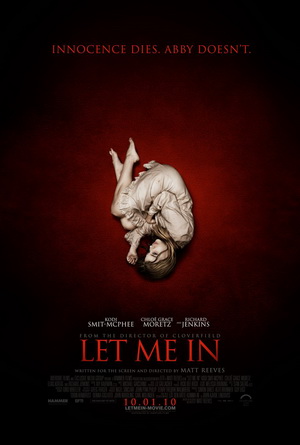
Let Me In is the American remake. Made by the Hammer Studio, revitalised under the American parent studio Enterprise.

Touted as a ‘re imagining’ not a remake, that old chestnut. So similar in plot, character and dialogue as to be embarrassing this is a perfect example of an American cash-in project. They took a critically applauded film, that the biggest paying film audience didn’t see, because they won’t, and made it in ‘American’. There’s nothing different, except the names and location.
Is it a good film? Yes, of course it is, it’s a duplicate of a really good film that already existed. And that’s the point, it’s totally redundant in its existence but for one reason. Dunderheads who can’t/won’t read subtitles.

These two films I feel sorry for really. Let the Right One In was a success for everyone involved, but it’ll never get seen enough. Let Me In is perfectly good, with great performances, but barely broke even at the box office. Did it deserve to do better? Probably. But that doesn’t mean it deserved to get made.

It’s the effort that kills me. How much effort does it take to read a subtitle? Too much it seems.

Decline & Fall – Evelyn Waugh


As part of a genuine lineage of literary masters, born from an age of class brilliance, public schools, officers in world wars, country houses etc, Evelyn Waugh was one of those Englishman that Americans and Australians are convinced we’re all still like.

Regretfully, we’re not. We are, of course, class mixed, socially removed from one-another, blended into an amalgam of so-called Big Britain. Balls.

What we actually are is exactly the same as always, we’re just fooled by our magazines and television nonsense to believe we’re a lot better off, and more rewarded for our nominal achievements in fashion and culture than we actually are.

Decline & Fall was Waugh’s analysis of this social climbing, and falling, and was an alarming premonition, in many ways clarifying a) what was happening at that time in the 1920s but also b) identifying what has continued to happen to this very day. But actually it’s just very funny. Following the highs and lows of Paul Pennyfeather in his attempts to better himself through teaching positions in increasingly dilapidated schools, with ever more desperate social climbers and moneyed brainless class ignorers. Ignorers, because they’re so high up that they don’t really know that they’re upper class, and they don’t recognise that other people really exist, or are actually people in fact.

Joining Pennyfeather on this journey is one of the better fictional characters to have ever emerged from comedic literature.

Grimes is a painfully funny contemporary of Pennyfeather’s, who meets him at the first school, run by the inimitable Dr. Fagan. After Grimes is sacked, horrifically wounded, arrested and up in front of a judge with a death sentence over him, he gets away with it, as he does with everything because he’s “a public school man”. It doesn’t matter that he’s a deserter pederast thief, because his class sets him free every time. He’s also optimistic, carrying on with the blissful gay abandon that his origination gives him. Like his contemporaries Waugh knew that he had a station above others, and that it was ludicrous, but that it really happened.

An honourable mention should also go to Prendegrast, the ex-CofE vicar who left the ministry because he stopped believing in God. His bishop however, not feeling this should particularly get in the way of his day to day duties, feels that he should carry on as normal.

Beyond this character of Grimes is the almost fantasy character of the Honourable Mrs Margot Beste-Chetwynde. Mother of Pennyfeather’s pupil, whom he goes on to tutor, then becoming involved with the enormously wealthy widow, only to discover her money comes from brothels in South America. Doing the decent thing Pennyfeather takes the rap as a sex-trafficking toerag and, again, falls from an apparently safe position, this time into prison.

Ultimately this is Waugh’s brilliance. He’s given us a character that should do better in life but, because he’s decent, he fails (falls). All around him are ne’er-do-wells that should, by rights, get their just desserts and be cast aside from their comfortable positions. They don’t, of course, and Waugh knew this from first hand experience, which caused something of a stink when this, his FIRST NOVEL! was published.

Characters show up again in different guises in his later books but, like Martin Amis’s The Rachel Papers, I don’t think pure comedic characterization has been replicated or bettered. Except maybe in the Sword Trilogy, but that’s for a another self-important and badly thought-out blog.

Coffee


>In England, where people are good and noble, clean and impressive, tea is the drink of choice. Tea is balanced, healthy and of a heritage that is the envy of the whole world. It’s as ancient as civilization and the benchmark for its continuance.

The development of tea drinking has accelerated over the last 30 years. Where before people were happy with a cup of tea, a splash of milk, maybe a spoonful of sugar and a few minutes of peace and quiet to drink the thing, there is now a dizzying amount of alternatives to confuse the decent among us. Of course tea varieties have been in existence for centuries, but people in general didn’t drink them, and people who did were assholes.

Darjeeling, Lapsing, Earl Grey etc etc. These are effectively pure leaves from individual plants that are developed for particular tastes. However, the teabags we buy in general – Tetley, Ty-Phoo etc – are blends that have been created to appeal to the widest possible group of people, and that’s why most people buy them. People like the average and they have no problem with it.
Not so with Coffee though.
Coffee is a foul product and the beverage equivalent of a functioning maniac. It has no redeeming features to align it with polite society. It smells, gives you bad breath, and makes your eyes twitch. But, it’s everywhere. Everywhere.
It’s almost difficult not to buy a cup of coffee as you walk down any street in Britain, but find me a cup of tea and I’ll accuse you of going to McDonald’s. It’s bizarre. It all goes back to the 1300s when coffee was first brought to England and coffee shops were established in London, then Oxford, Cambridge etc. Ironically, tea shops are all the rage in France right now.
Anyhow, coffee. The appeal seems to be threefold.
1. Convenience.
It’s easy to make a cup of coffee. Anyone can do it, and you can do it for anyone, unlike the minefield that is making tea for someone you don’t know. With coffee it’s just coffee in, water in, milk in then ‘do you have sugar?’. Actually, just put the sugar in. Also, as mentioned previously, you can get a coffee anywhere so, even if you don’t want one, you’ll probably buy one. People love to be seen to have done so too. Tools.
2. Exoticism.
Strangely coffee is still a little exotic. Americans drink it, don’t they? And those French, Spanish and Italians. But it’s also because it comes from so far away still and from places we, as an Empire, never owned. Tea comes from India, and we all know India, but coffee comes from Guatemala, Chile, Indonesia etc. Exciting! As long as you avoid thinking about the cocaine cartels.
3. Choice.
Yes, you can have anything you want when it comes to coffee, and people do. Ask for a cup of coffee in the next Costa or Starbucks and check out the weird look you’ll get. Frappucinos, Cappucinos, Lattes, Mochas, Soya, Vanilla, Sprinkles, Foam, Cream, Stop! Stop!.
Honestly though, there is only one reason that we drink coffee. It is not the choice, variety, convenience or excitement. It’s not even the style effect, and it is not the taste, so stop thinking that. No, it’s the caffeine. Coffee wakes us up and/or keeps us awake and that’s what it’s for.
So, really, it’s a polite and socially acceptable form of amphetamine. I don’t know about you, but I feel less comfortable with the idea of people dragging lines or popping pills in the street rather than sipping their Macchiato on the way to work. Just eat a mint afterwards, ok? Please?

Beards


I originally composed this as ‘Facial Hair’ but, the more I thought about it, the more I realised what an enormous subject that truly is. So, I’ve started with the big one: Beards.

Beards are the oddest of all stylistic accessories. They are theoretically accessible to any man (and some women of course), so are the epitome of an inclusionist option, but they are taken up by very few. This is because, even though they are an entirely natural and organic part of our physical make-up, they are treated as a style point and consequently go in and out of fashion.

Back in the 60s, 70s and 80s it was entirely acceptable for a cut-and-thrust young man about town, to sport a total chin-covering beard. In the 60s and 70s particularly the massiveness of the beard was encouraged, to the very limits of the chin’s ability to sprout. In the 80s however, and here’s where the warning signs started to be seen for the beard’s imminent demise, there was the filthy descent into designer stubble, so let’s start there.

Designer Stubble – Shocking stuff. Favoured by American TV cops and George Michael. Has all the appearance of a tea bag having been opened up onto someone’s face, which had already been covered in mayonnaise, and carries all the appeal that that has. The idea that one would sculpt this merest of growth, and then trimming it like the front lawn, is preposterous. Only now ever mentioned in piss-taking fashion about someone’s weekend stubble, so thankfully gone I feel.

Goatee – A well known, and actually quite old, piece of face sculpture. Can look OK actually, but you need the cheekbones and jawline for it. The problems come when your second chin is visible below the goatee. Then stop it. Also, to be worn, without a ‘tache, on its own is risky. Few can manage it, and you aren’t one of them.
Chinstrap – This is bloody silly. Basically a tiny line of fuzz that follows the jawline. Tiny. It’s so stupid I just can’t be bothered.

Underbeard – I think these are grown for two reasons. 1: to show off that you can. 2: to cover up shaving rash or massive second chin. Either way they draw more attention to it and make everyone think you’ve got something that’s gone wrong. Which, of course, you have.
The Grace – Favoured by WG Grace this is the long beard that just says ‘fuck off’ to everything. Only to be worn by old, wealthy men who are interested in politics, war and cricket and have done them all. Oh, and Rasputin, who was the ultimate badass.
Fat Man’s Beard – As odd as their propensity for shorts-wearing in all weather is the fat male’s habit of cultivating their facial hair. They never really grow a beard, they actually just allow it to develop and either can’t be bothered to get rid of it, or they use it as a distraction method. It just shows them up, it’s awful wrong.
No ‘StacheA proud, Quaker-ish affair that is used by a few distinct and impressive men. Obviously these people are mostly mental and generally people think of Michael Eavis with this. I prefer to think of mid-Western American loners.
 
Full Beard – Now, here we go. The Full Beard, joining sideburns and moustache in its coverage, is a marvellous thing. It it large, noble and proud. Where it can fall down is if it’s wispy. A wispy beard of great size is quite poor showing and should really be totally reconsidered by the owner. I would concede to the need for a shave here. This problem is especially prevalent for ginger men, but the issue is really neither here nor there for those poor bastards.
I’ve never worn a beard, because I have a couple of tiny patches where stubble doesn’t form, so I need to go past a couple of weeks of messiness to get to the good bit. Women, astonishingly, don’t like this much. They call it messy and complain about scratching. I think everyone needs to take a long look at themselves and get their damn priorities right.
Beard, after all, equals success.

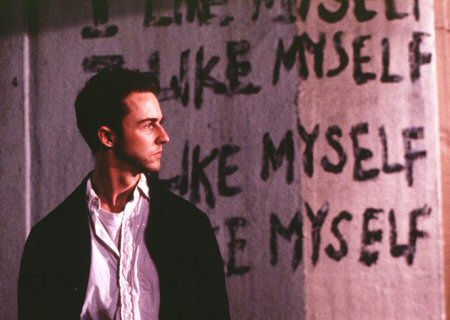
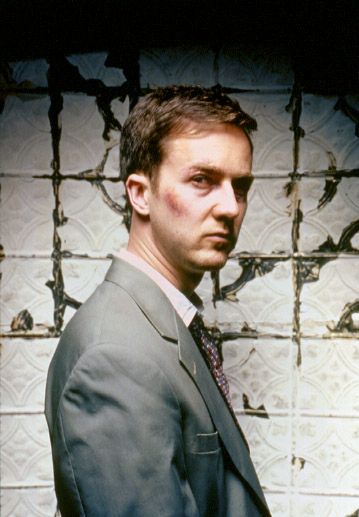
Fight Club (film, not book)


>
The film indeed. For it is this, and not the book, that has seared itself onto the public consciousness. In a multi-media age even the DVD of Fight Club seems old fashioned now, but the book is a practical irrelevance for too many people, so I’ll park that for now.

Even Chuck Palahnuick himself was surprised that anyone would be interested in the book, but when the film came along as an option, it seemed perfect. Reading the book it feels as though you are reading a well-crafted screenplay, and the movie is super-faithful to it.

When David Fincher took this on the people in the know suddenly paid attention. Then Ed Norton got on board, then Brad Pitt, then Helena Bonham Carter. Wait a minute…

What was delivered was a statement on existential mid-90s angst at lost fathers, emasculation, corporate identity battering, commercialisation and an insipid numbness that could be awoken though nothing short of a punch in the teeth, delivered in the empty car park of a bar in the middle of an amorphous city in the dear old US of A.

But, Fincher and Co did a lot more than this. They delivered a really cool film, and that’s why we love it. There is no man who doesn’t want to be Tyler Durden, doesn’t identify with Norton, doesn’t feel repelled but magnestised by Marla. And, I’m sorry girls, but this is a man’s film. I don’t care what you say.

It’s a man’s film because it’s who it’s about, and for, from it’s very inception. Tough. But it’s clear that this isn’t a promotional feature for men, it’s a wake up call. Well, the book was, this is about capitalising on that of course, but it’s still top drawer.

Norton’s office drone, with astonishing detail and affecting tasks at his fingertips as an insurance investigator, is the everyman we see in the mirror everyday. He is bored, psychotic, numbed and lost. So, (spoiler here! look away) he creates the alter ego of Tyler Durden to wake him up. Tyler is everything he wants to be, and so do we. So they get that lucky bastard Pitt in.

Brad Pitt is a terrible lead actor, but a great co-lead. He bounces off of people excellently, and Norton’s acting chops are excellent foil for his inspired idiocy. He is Tyler, and the swagger, grin, slouch and stare are all directed to Norton, if not then he’s breaking the fourth wall, an often tiring device that is perfect in a film that is actually just about talking to the viewer all along.


The underlying theme is of men remembering that they are men and are not tied into the commercial and social ties that they’ve grown up in and are unwittingly part of. They can break out and Fight Club is the first step. Following this it’s about rebellion, destruction, anarchy and a few other hopeless causes, but mainly it’s about Norton’s battle with himself. And, therefore with Tyler.

What starts as a buddy movie, turns dark and violent (beyond the punching) as Norton fights are directed inward, so stop himself from turning into something he’s not sure he goes along with. Actually he does. It’s also kind of a love story, and that’s really rather sweet in the final analysis, even though after the first few viewings I found myself wishing Bonham-Carter out of the film. The character really, but I think HB-C is the same in every film.

Is the world set on a course for killing our individuality, globalisation, corporate rape of the human soul? Do we, as men, have any power left, and recourse to break out? Maybe, but if we don’t we can always just watch a good film about it.

Fighting


One of the most significant films of the 90s, a sleeper hit that people in the know really weren’t sure would gain traction, is Fight Club. The subtext of fighting as an anathema to 20th century consumerism would, they said, go over people’s heads. The brawling in place of meaningful existences would, they said, pass people by. They were right, for the most part, but they were ultimately so wrong as to be embarrassing.

What people, viewers that is, understood about Fight Club was that it was about ‘something’. They may not have wholly understood what that was, but they knew it was deeper than the punches. That’s why it was successful and is rightly revered today. People got the nuances, the discontent, the inner rage, the emasculation, the angst – they got why they should see it again and again. Even if a goodly amount of fools just want the violence.

But, it’s a sham film, and this is why. The fighting looks too good. Aside from one bit at the beginning, in which there’s a comedic leg-grab from Ed Norton’s character, the punches are swift, well-placed and theatrical. The men, toned, rough and tough. Again, one exception in Meatloaf’s steroid-induced mega-boobed fatso comic relief.

Fighting, amongst ordinary people in situations with no rules or referees, is terrible. It’s not really fighting at all. It’s, at best, brawling with intent. Grabbing, shoving, scratching, kicking and maybe, just maybe, punching.

The trouble is that people have been suckered into the glamour of fighting and don’t realise that it won’t be in slow motion, pacing around, with people regularly taking solid right hooks to the face and still coming back for more. How many times have you seen or heard about people getting shattered jaws, smashed cheekbones or popped-eyeballs. That’s what actually happens when someone punches you in the face. I got punched once, it was a rubbish one too, I didn’t really realise it was what had happened, and I had a completely bloodshot eye for 3 days.

In the street, outside pubs, inside nightclubs, on housing estates, in private clubs, schools etc etc. It’s scrapping that happens. Big build ups or flash events, these are the same fights you have had since you were 7 years old, and they’re as impressive.

‘I’ll punch his lights out’ you’re thinking. You won’t. Best result is you’ll get one in and not have your shirt ripped off, which is what inexplicably always seems to happen. Worst result is you’ll kill him. Blunt trauma, nasty.

Fights have always bemused me and I think it’s because they’re one of those things that, in a modern society, have no place. They’re an irrelevance and the simple truth is that our menfolk are pussies because of it.

We posture and preen, pose and pout. It’s sickening to see. It’s like the animal world has said ‘Hey, we have to do it. What about you?’ This prettification of simple, classless men, with their straighteners, highlights and waxing, is a result of the lack of real machismo, the kind that wars, poverty and revolution gave to people. Now the poorest people in the land have the largest tellies and all go out on the Friday night.

Makes me want to kick their heads in.

Hats


There was a time, long ago now, when men wore hats. They wore hats, because they were men and they wore a hat. This was nothing more than the done thing. When you left the house, you put on your hat. When you got to work, you took it off. When you left work you put it on again. When you got to the pub, you laid it on the bar and sipped your mild whilst filling your well-earned pipe.

It was a thoroughly decent and respectable thing that was no more unusual than thin lapels, button-down collars, smoking, war with Germany and rickets.

But, times change. Hats no longer maketh the man, unless they maketh him a total cock. It’s sad, for any number of reasons. But the variety of reasons, like the variety of hats these days, is the actual problem.

In the 1930s, men wore trilby type, fedora hats. They were brown or black, had a top crease and looked frankly excellent. This continued into the 1940s and 50s, but in the 60s, for God only knows what sickening reason, it all stopped. Apart from the bowler-hatted gents of the city, and the dwindling flat caps on the North, the hats were gone. Poof!

So now, when people wear hats they are really making a point. Unless it’s a woolly hat on a cold day, or a brimmed hat on a hot day, they’re a fashion accessory or a style choice. A statement. They should be loathed and derided at every stage. So, let’s get started.

Baseball Caps: Fairly innocuous these days, so common are they. I imagine you own one. But they are stupid imports and people wear them to look ‘cool’. They don’t

Flat Caps: Almost ok. Almost. They are an affected look, and often the effect is to make one look like an avant-garde tool. x100 for Berets.

Woolly Hats: There was an effort to rename them beanies, so that they could become a fashion accessory of real standing. Like all forced fashion the wearer is, if it’s not bloody cold, quickly identified as a waste of effort.

Leather brimmed hats: These are almost exclusively worn by overweight, pony-tailed, 35-45 year old, Games Workshop loving, chinless wonders, who have girlfriends that look like they do, and probably have a long trench-coat to match the hat.

Mini-trilbys: Assholes. Total bloody assholes. I just can’t even think about this without picturing the ‘men’ who wore these. Gladly it’s pretty much stopped now, probably when they realised that, without fail, their hats were cooler than they were.

Skull Caps: Non-Jew wearers here of course. These are the kind of people who also wear too-short trousers, ethnicky smock tops, sandals, have small beards and are ‘in tune’. They are also, ‘in denial’.

Russian/Tibetan/Stupid Ear Flappy Winter Wear: You know, warm hats imported, in design at least, from seriously cold countries. You used to only be able to get them from army surplus shops, now people wear them for real. So they look like a politician visiting Moscow. Or, the dangly goat-herder crochéd hats, to look ‘real’. Both look literally unbelievable.

Panama Hats: Now, ah, wait a minute. I really only see older, well-to-do gentlemen wearing these. Gents who probably like the cricket too. So, these are ok.

I used to wear a hat like this, then I saw my reflection, so I don’t anymore. Hats are only for girls and professional people who need to. Men need to just hang on, wait for the suit and hat revolution to return and then dust off the pipe and get down the bloody pub.

Hiring a Van


For most men in this day and age, an age of information technology and electronic communication, we go to work, sit at a desk and tip-tap away at our keyboards and feel all very clever and important about whatever mindless and irrelevant form-filling and box-ticking we’re engaged in.

There are few people in white middle-class Britain who are not, in some way, employed in this fashion, sitting behind a screen, eyelids drooping, backs aching, stomachs expanding. The alternative is shop-working. Standing behind tills, tapping away, or more likely just beeping away, and staring at another screen. At least these poor buggers are on their feet all day.


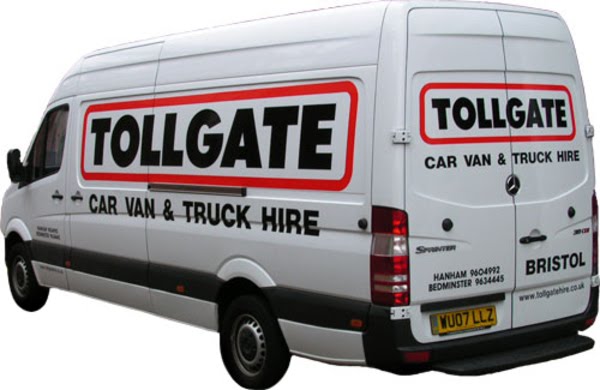
Where these millions of men, emasculated by modern consumerist society, pinioned by an IT revolution in the UK, find their temporary release is when, with fear in their blood and anticipation trembling through every fibre of their being, they go and hire a van.

It’s probably because they’re moving house, and so it may well be once or twice in their life, and this makes it even more exciting. It’s really a kind of ritual, starting from the decision making, picking up the Yellow Pages, going for the ones you know, realising that there are others, phoning a few, trying to sound confident, knowing they deal with idiots like you every day, agreeing to take a certain type of van and not being wholly sure what you’ve agreed to, because you still only really know what a Transit is. You’re also shocked by the cost, although you agreed to make sure you don’t seem like you haven’t done this before.

Turning up is panic-stricken. You’ve got your license, but they’ll be able to see that you’re not a van driver, so they’ll think that you’re not capable of dealing with the van. You’ve got your extra proof of address, but probably couldn’t find good ones (like bank statements) and are worried that you’re not going to be allowed to take the van, and you’re definitely on a predetermined timeframe that your girlfriend or wife has decided on and, if you don’t get the van NOW, then you’re dead.

But, you get it. You have to check it over with the hirer, and you fraudulently nod ‘Yeah, it’s ok’ as they make you look at the bumpers and front wings for scratches. You haven’t got a clue.

So, you’re in and you start up. Probably a little disappointed that it isn’t completely alien inside, and pretty much like your car. Higher up and different angles to reach things. No rear-view mirror, which is pretty radical. I guarantee that you will put the radio on straight away, and here’s where the exciting stuff starts.

You now have some short-term opportunities for personae change. Things you can now do and be that you have no other chance to do in your normal life.

Radio 1. You’re almost obliged to listen to Radio 1, and you don’t mind so much. With the window open too. You have to drive with the window open and, with only 10 minutess behind the wheel of this new beast, you lean your elbow on the window ledge. You also stare at women, shamelessly. You might actually really be uninterested in it, but it kind of seems right and, honestly, they don’t mind. IT’S TRUE.

Moving on. You now have new rights to the road. Oh yes, this is where some really cool stuff starts. You know the way you’re wary of van drivers when you’re on the road? Well, now people are scared of you!! Oh yes sir, you just go ahead and pull out just whenever the hell you want. Change lanes if it takes your fancy. Drift across those lanes like it’s the most normal thing in the world. Another thing – having trouble pulling in or out? Other van drivers will stop traffic for you!! They bloody do! It’s like you’re immediately in a brand new special club. They don’t know that you’re a total amateur and, by now, you’ll be acting like being a van driver is what you’re all about.

And this is the final point. You have, by now, 3 hours in, developed a relationship with your van. You swing it around the corners with complete authority. You know all the little quirks of your van, the things that make it work and tick along, but, specifically you know the back doors. This is why you’ve got the van of course, it’s for the big loadspace and the back doors. So, you’ve got the double-locking, double-hinged doors and probably a side-sliding door. You’ve opened and closed it a few times and you now know how to do it and, most excitedly, you do it authoritatively and in a no-nonsense fashion, when other people come to help you out. You do it like you’ve been doing every day of your life. It’s you and the van together, forever.

But, no. The time ebbs away all too fast you’re back and dropping the van off. You do it quickly and emotionlessly, plopping the keys on the counter and a quick ‘Cheers, mate’, almost dismissively. But, you don’t mean it. You feel sad. You wish it was your van.

Being back in your car is now somehow lessening. You feel exposed and vulnerable. The car is too light, wussy and you know that, at any minute, a van could shove you out of the way, and you’d deserve it.

13 years ago…


>…I was 20, and I thought that everything would be oh so fucking sweet and cool, and everyone would be doing things they’d really love, and expectations would only grow and grow as achievements were continually being ticked off and logged away as successes in people’s life experience folders. The folders they keep in the backs of their minds and hopefully don’t pull out at random and start trying to impress you with in the middle of a conversation during some chilled out and fun evening, especially when the ‘experiences’ are about travelling, or drugs. Booooring.

So, it turns out that actually life moves at approximately 1,00,000,00,000 miles per hour, and I’m 33 all of a sudden. But that’s not all. I remember when I was 20, and thinking ‘Shit. I remember being 15’.

People always say that life passes you by so fast, and you’ll regret not doing things, leaving things until tomorrow, not taking opportunities and chances. That is so true. It’s a stark wake up call for me to be realising this already as, hopefully, I’ve got another 60-odd years before I shuffle off of this mortal coil and suddenly find God as I’m slipping into death and realise that I’d be well off getting myself some insurance.

Now, I find myself looking at what I’ve achieved, and it’s not much. Media tells us that if you haven’t achieved fame then you’re nothing. If you aren’t a singer, a film star, an activist, a politician, a criminal or whatever else it takes to get into the papers or on the TV then you ain’t worth shit. The tribe of ‘Celebrity’ has begun to infest our common consciousness and is setting new levels of non-entity that, nevertheless, people revel in and, darker still, believe.

I think that I should like to find something morally and spiritually fulfilling to spend my time with. Not spiritual in a religious sense, as I believe religion to be bunk, but something, some calling or task, that will send me to sleep with a smile on my face and wake me up with enthusiasm in my mind, instead of my dragging myself to slumber with a heavy heart and waking every morning with dread etched across my brow.

I don’t think this is so difficult, but I can’t think about it now really. I have to get to bed as I’ve got work in the morning. Shit, have I done those figures….?

Tombstone


Right, let’s not mess around here, I love Gunfight at the OK Corral. Burt Lancaster, Kirk Douglas, great. But this film is something else altogether.

It’s not so much a remake as an improvement and, yes, I dare say an improvement, because it’s just a better looking, directed, scripted, acted, produced and presented film. Hands down, it wins on all fronts.

The story is the greatest of Westerns, and one of the most iconic of real stories about the emergence of the Old West from a lawless bloodbath to a managed democracy for families. It also totally kicks ass, by the way.
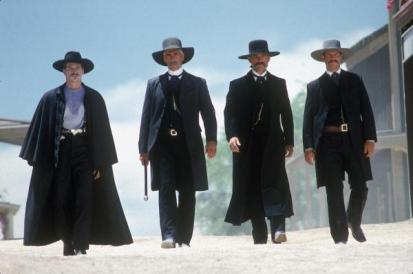
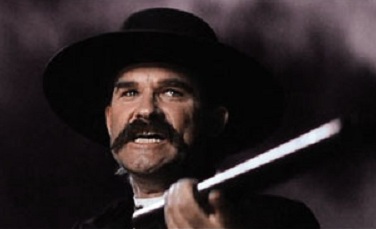
Wyatt Earp is played by Kurt Russell, an almost comic bit of casting at the time, what with Russell’s comedy/drama, comedy/action, comedy/shit films around the time. As it turns out it was inspired casting and he forms the core of an excellent quartet of wrought-iron lawmen.

At the core of Tombstone is, of course, the story of the Clanton’s family’s wrong-doings and the decision by the town (of Tombstone itself) to ask Wyatt Earp, to help sort out the Clantons and their Cowboys. Virgil, his elder brother, becomes infuriated with the lawlessness of the town and signs up to be Marshall. The resultant showdown leaves most of the Cowboys dead, whereas the following gunfight, a revenge attack, leaves the youngest Earp dead and Virgil with a crippled arm. Wyatt eventually kills everyone, with help from his old friend Doc Holliday.

In truth that’s it, but the film is more than that. It’s a story of family, honour and decency. It’s about good vs evil, strength vs cowardice, truth vs shame and deceit.

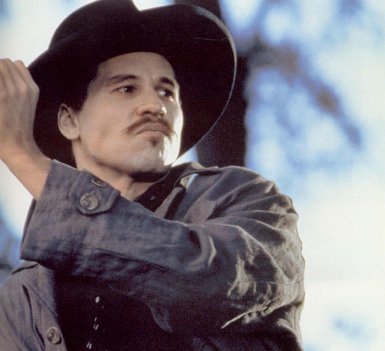
More importantly this is an excellent film with great performances from a slew of B-actors. Russell stars and directs, Bill Paxton is his younger brother and Sam Elliot as his older brother Virgil. Michael Biehn and Jason Priestly, Billy Bob Thornton, Thomas Haden Church, Powers Boothe. It’s got something like 85 separate speaking roles, including Robert Mitchum narrating the damn thing. Charlton Heston even shuffles in. The main man though, shoulder to shoulder with Russell, is Val Kilmer.


Kilmer as Doc Holliday is perfect casting. The Louisiana man with the slow delivery, the constant drink on the go and the lightening gunslinging. He’s inspired foil for Wyatt, who is played straight by Russell, but always with a sense of surety. Holliday is the only one who accepts that Wyatt is a killer, revelling in it in fact, although mainly because it feeds his respect for the man.


The casting is great. Virgil is stoical and as western as a man could be in Elliot. Morgan is played simply by Paxton as a keen but inexperienced brother. Russell and Kilmer are frankly better than Lancaster and Douglas. But, what really makes this film are the fight scenes.

From the beginning to the end it doesn’t disappoint. Gunslinging has never been so brief, noisy and effective. No long range, long distance shootouts. This is fast, dirty and painful looking. Doc is in agony the whole way through the film and people get shot in the hands, arms, legs and shoulders. Not straight in the torso as you’d expect. The OK Corral shootout takes about 35 seconds, it’s tremendous.

Only the exchanges supersede the bullets for their devastating effect. The pithy asides, snide comments and direct challenges are all foreplay for the six-shooters, but essential foreplay. Wyatt’s determination to be the man he wants to be, and Doc’s determination to wind everyone up, make them as responsible for the bloodshed as the Clantons, but that’s the way of the West to be sure.

Final note on Doc. He’s got two of the best lines in the film, for two different reasons each. One is where Wyatt agrees to go with Virgil to the OK Corral and Doc steps up. Obviously ill, from tuberculosis, Wyatt tells him it’s not his fight. “Well, that’s a hell of a thing for you to say to me” Doc replies, half mockingly and half seriously hurt and offended. Confronting Ringo (Michael Biehn) at the end of the film, his nemesis since half-way through, he simply says “I’m here Huckleberry”. Ringo has told everyone what they already know, that he’s the fastest draw in town, and wants Doc. The viewer expects Doc to at least take a fatal bullet but, he simply shoots Ringo in the head before he’s drawn his gun. It’s so fast. The derision in Doc’s comment is the icing before the cake as it turns out.

Massively successful and, unfortunately for Costner, beating his own Wyatt Earp to the box-office, Tombstone is a solid and re-watchable film. The ensemble deliver faultlessly and Russell became a leading man to respect. It was Kilmer who delivered the goods ultimately and, HEAT aside, I doubt he’s done, or will do better.

Design a site like this with WordPress.com
Get started